
Myopia Management

What is Myopia?
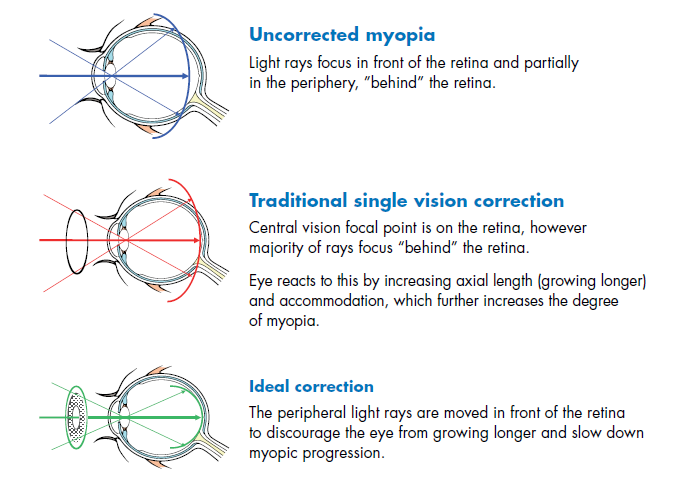
Myopia (nearsightedness) is an eye condition where vision is blurred for distant objects, such as the TV or the board at school. Myopia occurs when the size of the eyeball is too large relative to the focusing power of the eye, causing light to focus in front of the retina rather than directly on it. The blurry vision is corrected with glasses or contact lenses to move the focus of the light onto the retina.
Myopia Progression
As a child grows taller each year, their eyes also grow longer. In most cases, the amount of myopia will increase over time as the child’s eyeball continue to grow—this is called myopia progression. It is associated with a stronger glasses prescription, more blur for distant objects, and an increased dependence on glasses or contact lenses.
Myopia progresses more quickly in a younger child and slows as the child becomes older. Other factors that may increase myopia progression include: ethnicity (particularly Asian descent), myopia in one or both parents, and younger age of myopia onset. Myopia progression usually stops in early adulthood, between late teens to mid-twenties.

Myopia Increases the Risk of Ocular Disease
The health of the eye can be jeopardized by myopia due to the larger size and subsequent stretching of the eyeball. Myopia dramatically increases the risk of developing potentially permanent and sight-threatening eye disease later in life compared to no myopia. These diseases include retinal detachment, glaucoma, early cataracts and disease of the macula. The higher the myopia, the higher the risk of developing ocular complications; however, even low amounts of myopia will drastically increase the risk of disease.
Myopia also impacts lifestyle. Glasses or contact lenses will be required to see far away objects clearly. As myopia progresses, it is accompanied by increasing blur, updates into thicker glasses, and more dependency on glasses or contact lenses. Higher degrees of myopia can impact eligibility for laser vision correction options in the future.
Myopia Management
To lower the risk of sight-threatening eye disease and improve quality of life, we strive to minimize the amount of total myopia by the time your child reaches adulthood. Luckily, several treatment options are available to slow myopia progression in children. Myopia management (also referred to as myopia control) will not reverse myopia and cannot be guaranteed to stop progression, but importantly, evidence-based research proves that treatment is effective to slow down the progression of myopia from year to year. Myopia will progress in children; it is important to begin treatment as soon as possible to minimize the total amount of myopia in your child.
Myopia Management Treatment Options
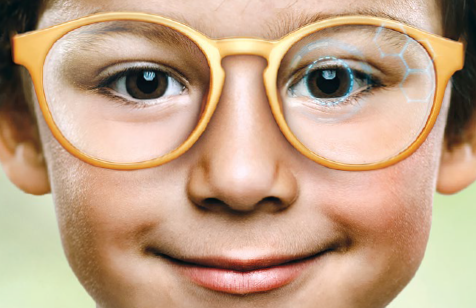
Currently, there are four effective and safe treatment options to slow myopia progression in your child. Your Optometrist will recommend a treatment plan based on your child’s eye anatomy and level of baseline myopia. It is also important to choose a treatment option that fits into your family’s lifestyle.
MiSight Daytime Soft Contact Lenses
Overnight Orthokeratology Contact Lenses
Atropine Eye Drops
MiyoSmart Glasses
How do you monitor treatment efficacy?
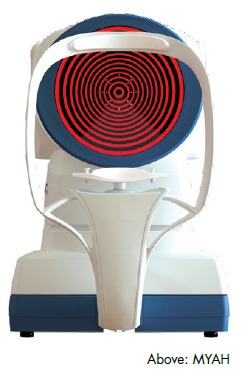
Our doctors rely on state-of-the-art technology to complement their clinical examination of your child. At every myopia control visit, your child will receive measurements by an instrument called ‘MYAH’. This amazing machine provides essential information to assess the risk of myopia and closely monitors the effectiveness of any myopia interventions. MYAH is an all-in-one device to support myopia management, measuring: optical biometry (eyeball length), corneal topography (surface curvatures and analysis of contact lenses), and pupillometry (dynamic pupil measurements).
What else can I do to prevent or slow down myopia progression?
Increase time spent outdoors
Reduce time on near work and screens
When can I stop treatment?
As myopia will continue to progress until adulthood in most children, myopia management is recommended until the late teenage years or early twenties to minimize the total amount of myopia. If treatment is discontinued earlier, myopia progression may resume along its usual course; restarting myopia control treatment should then be considered.
Glasses, soft contact lenses and orthokeratology contact lenses are wonderful options to correct blurry distance vision. Their use can be continued well into adulthood. For atropine eye drops, we recommend discontinuing use in late teens or earlier twenties, when myopia is stabilized and the risk of progression is low.
Further reading
www.mykidsvision.org
www.myopiainstitute.org